
Spring and the Soul's Return
- Apr 8
- 4 min read

Tulips, photography Rebecca D'arcy
On the Spring Equinox this year, I held a one-day workshop on The Alchemy of Goddess Archetypes in Psychotherapy at the Psychosynthesis Trust, which explored this process. The workshop was held for the therapeutic community, which included therapists, holistic practitioners, students and people interested in archetypal psychology. It was open to all; however, it happened to be that the 24 signups were all women. We discussed this as a group. Some felt that it created a sense of safety and sisterhood, and others would have liked men to have been involved too, to engage in this work and hear the feminine perspective.
In the workshop, we explored the goddess archetypes as a general principle then focused upon Aphrodite and the story of Psyche and Eros, and then the myth of Demeter and Persephone. All three goddesses hold meaning and relevance for psychotherapeutic work. Together, we explored this through entering the spirit of the myth through meditation, music, movement and group process. I encouraged focus on both the archetypal level, where an experience of the symbolic, mythic realm can be felt, as well as considering the issues from a feminist, intersectional perspective.

Setting the tone for safe space is important. Prior to the group’s arrival, I set out the room with an altar in the centre, with a red altar cloth, a pomegranate -sacred to Persephone, and apples, sacred to Aphrodite. Red tulips honoured the season, and I placed images of the three goddesses together with sheaves of wheat, a symbol of Demeter. I also placed a single wheat sheaf on each seat, ready for each person to enter the experiential journey. My intention was to create a temenos, a ‘sacred precinct’ to hold the work, reminiscent of the therapy room and also a symbolic invitation to enter a mystery, an experience of what the mythic can offer. Additionally, we formed a group agreement honouring confidentiality, inclusivity, and kindness. Further pathways to enter the sacred were meditation, inviting a symbol to reflect the calling, storytelling, movement and music.
There was a discussion around ‘what is the sacred feminine’ and ‘what is the difference between the feminine and the sacred’. It was felt by some that the sacred is important, a reclaiming of something that has been suppressed, it felt necessary for women, and all people, to connect with the sacred. In today’s world where we are so separated from nature, we can feel split off from the ground, the body and the sky. This is an issue that can affect anxiety and stress levels, create divides in the psyche and splits between body and mind.

Aphrodite is a goddess who presides over the body. She personifies vitality, life force, creativity, fecundity, nature and the feminine body. We touched upon what it can mean if Aphrodite’s energy feels absent, and how it can be possible to reconnect through creative practices such as poetry, art, dancing and swimming. Aphrodite is a complex deity whose origins are rooted in the Ancient Near East, where she was aligned with goddesses of love and war. There were some representations of Aphrodite as a war goddess in Ancient Greece and Rome, but they have been suppressed by the patriarchy. As a group, we looked at the implications of what can happen to women’s power when cultural images of the sacred feminine no longer embody qualities of the warrior.
We discussed how Aphrodite is also a challenger, as represented in the myth of Psyche and Eros, she leads Psyche through a series of trials which leads to deep transformation. Psyche, whose name means soul, is a mortal princess who is often described as representing the human psyche, who, in the journey of individuation undergoes trials to ultimately find wholeness. When Psyche was separated from her beloved Eros, Aphrodite sets four impossible tasks that must be overcome if she is to be reunited with him. One by one, Psyche attends to the tasks and receives help from unexpected sources, which ultimately lead to her reunion with her beloved and achieving immortality.
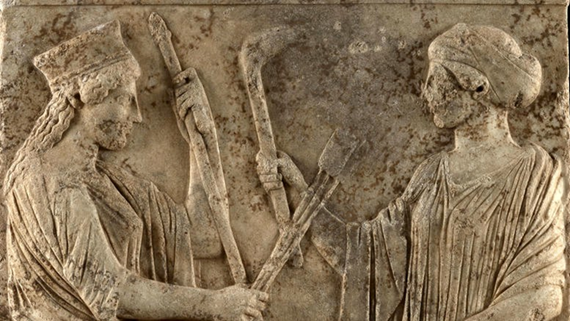
In the afternoon, we moved into a deeper, experiential journey into the mysteries of Demeter, Goddess of Grain, and Persephone, her maiden daughter whose abduction and forced marriage brought Demeter into a deep process of grief that caused barrenness over the entire earth. This has profound meaning for how we can sometimes experience grief, as all pervading, robbing us of the vitality of life. When we are grieving, it can feel as if nothing grows. Demeter goes through a long journey of searching, anger, longing and finally, reconciliation with her daughter. This myth demonstrates an enactment of the seasons. It can also hold up a mirror for an experience of trauma, where young parts of the self may be trapped deep within the psyche.
We entered into the story through meditation, movement and dialogue. It was interesting to see how participants experienced the myth through different perspectives, depending on what was relevant to them. The group explored personal meanings of the myth for themselves and their clients through paired sharing, group process and active imagination. Some of the themes that emerged in the workshop included nourishment, creativity, underworld, soul, women and the sacred feminine, trauma, women’s bodies and lost parts of the self.
“Stories are medicine. They have the power to guide us, to reshape us,
and to remind us of who we are.”
Saffron Rossi
I am currently writing a book about this topic, and will be running other workshops in the coming future. To keep in touch please sign up to my newsletter:


Comments