
The Autumn Equinox: Demeter, Persephone and the Psychology of Descent

At the autumn equinox, day and night stand briefly in balance. From this point onwards, the days begin to shorten and the natural world turns towards darkness, dormancy and rest.
In the agricultural cycle, this is the season of harvest: a time to gather what has ripened, to acknowledge what has been gained, and to begin preparing for the months ahead. Psychologically, autumn can also invite us into reflection:
What have we gathered from the year?
What needs to be released?
And what happens when life asks us to let go of something we are not ready or willing to lose?
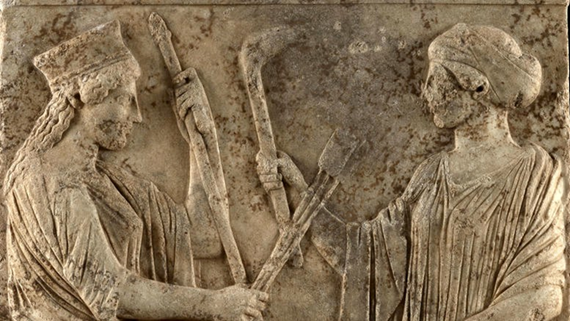
The myth of Demeter and Persephone offers a powerful symbolic language for these experiences.
The Descent
In the myth, Persephone is taken into the Underworld by Hades, Lord of the Underworld. Her mother Demeter, devastated by her daughter's disappearance, withdraws her fertility from the earth. Crops fail, the land becomes barren, and the world enters a period of suffering.
Eventually, a compromise is reached. Persephone returns to her mother for part of the year, but because she has eaten pomegranate seeds in the Underworld, she must also return there for part of each year.
The story has often been understood as an explanation for the changing seasons. Yet its psychological significance reaches further.
It speaks to something we encounter repeatedly in human life: the necessity of descent.
There are times when life moves us away from what is familiar. A relationship ends. A child leaves home. A career changes. We experience bereavement, illness, menopause, burnout, or a crisis of identity. Sometimes nothing obvious has happened, yet something within us begins to change, and the life we once inhabited no longer feels quite right.
These experiences can sometimes feel like a personal Underworld.
When The Old Life No Longer Fits
From a depth-psychological perspective, psychological development is not always an upward movement towards growth, happiness, certainty or achievement. Sometimes development requires us to move downwards and inwards.
The descent can be uncomfortable because it interrupts the identity we have constructed. Sometimes the loss can feel excruciating.
We may have been accustomed to being capable, productive, caring, or successful. We may have known who we were in relation to our work, our family, or our relationships. Then something shifts, and the familiar answers no longer seem sufficient.
There can be a temptation to try to rush out of this uncertainty.
We may try to fix ourselves, stay busy, find another relationship, make a new plan, or return as quickly as possible to the person we were before.
However, The Myth of Demeter and Persephone suggests that it might be necessary to stay with the process.
Demeter and the Experience of Grief
Demeter's response to the loss of Persephone is psychologically recognisable. She cannot accept what has happened. Her grief becomes a force that changes the world around her.
Grief can be like this.
It can affect our relationship with time, our bodies, our sense of meaning, and our ability to participate in ordinary life. What once felt effortless may become difficult. The world may seem strangely unfamiliar.
Rather than treating grief as something that must quickly be overcome, depth psychology allows us to ask what the experience might be asking of us.
What has been lost?
What part of ourselves has been changed by that loss?
What can no longer be returned to exactly as it was?
And what might need to develop in response?

Persephone Returns Changed
One particularly interesting aspects of the myth is that Persephone does not simply return to the life she had before.
She has crossed a threshold.
She has experienced another world and, through her descent, acquired a different relationship with herself, including a different name. She is no longer simply Kore, the innocent daughter. Kore becomes Persephone, Queen of the Underworld. She now belongs to both worlds: above and below, light and darkness, life and death.
Psychologically, significant life transitions can mirror this process.
We may emerge from difficult experiences changed. Sometimes this change is painful. Yet it can also bring a deeper knowledge of ourselves, a greater capacity to tolerate uncertainty, and a different relationship with the parts of ourselves that previously felt unacceptable or unknown.
The aim at such times is not necessarily to return to who we were. It may be to become more fully who we are.
Demeter and Persephone Retreat
This theme of descent, grief, transformation, and return is at the heart of the Demeter and Persephone Retreat that I am co-facilitating with Fay Barratt, in March 2027.
Over three days, we will explore the myth as both an ancient story and a living psychological and symbolic journey. There will be space for reflection, depth-psychological exploration, embodied practice, and creative work, with Fay bringing her experience of sacred art, group facilitation and spiritual practice to the retreat.
The retreat takes place 19 - 21 March 2027, and is an invitation to step out of everyday life and into a more contemplative space: to explore what it means to descend, to grieve, to transform and, eventually, to return.
If the Demeter–Persephone story speaks to something you are currently living through, you can find out more about the retreat [here].


Comments